
North American P&C insurer executives and IT decision-makers are operating under mounting pressure from six converging forces: legacy system constraints that fragment data and slow decisions, accelerating climate risk that outpaces legacy exposure modeling, rapid E&S and specialty market growth demanding complexity management, talent attrition that removes irreplaceable institutional knowledge, broker and distribution partners demanding faster quote turnaround, and portfolio management complexity that is now a board-level concern. Together, these forces have made the status quo untenable. Carriers staying on disconnected legacy platforms risk losing broker business to faster competitors, exposing portfolios to unmanaged concentrations, and entering a talent crisis without AI-augmented processes to compensate.
The conventional assumption that all underwriting workbench vendors are broadly comparable is wrong. Datos Insights’ research—covering direct RFI responses, live platform demonstrations, and insurer interviews across 21 vendors validated through Q1 2026—reveals that the market has bifurcated architecturally. A capability gap has opened between AI-native platforms executing end-to-end agentic workflows and vendors bolting AI onto legacy architectures. Three capabilities will separate the next generation from the current one: autonomous agentic underwriting that executes submission-to-quote with minimal human involvement, continuous underwriting with real-time material change detection across the policy life cycle, and closed-loop feedback that routes signals from claims and billing back into underwriting AI models. Only a small number of vendors have any of these in production today. Carriers evaluating workbenches on feature checklists alone will miss the architectural distinction that determines whether a platform can sustain continuous AI improvement or will plateau within three to five years.
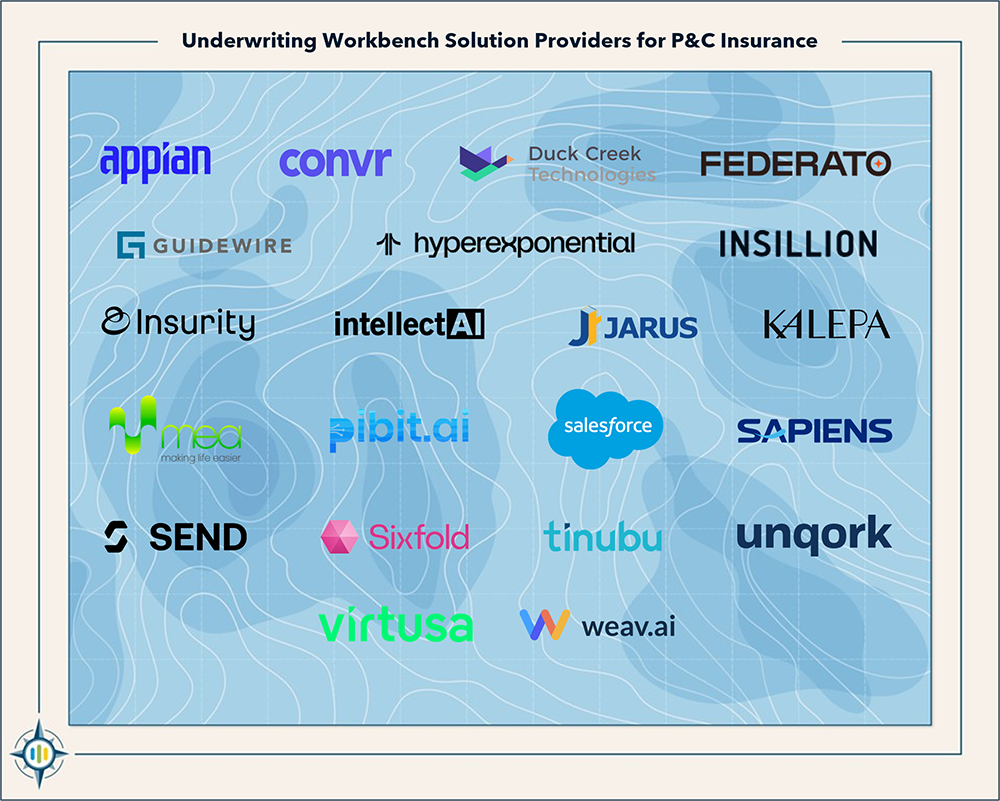
This report provides a comprehensive market analysis focused on the evolution, maturity, and capabilities of underwriting workbench solutions designed specifically for property and casualty (P&C) carriers. It profiles 21 leading underwriting workbench solution providers serving the North American P&C market: Appian, Convr, Duck Creek Technologies, Federato, Guidewire, hyperexponential, Insurity, Insillion, IntellectAI, Jarus Technologies, Kalepa, mea Platform, Pibit.AI, Sapiens AdvantageGo, Salesforce, Send, Sixfold, Tinbu, Unqork, Virtusa, and Weav.ai.
Clients of Datos Property & Casualty service can download this report.
About the Author

Other Authors