

After conducting data maturity assessments with a range of carriers over the past year, we’ve uncovered a surprising pattern that challenges conventional wisdom about data transformation. The most startling revelation? Having strong data governance doesn’t guarantee usable data—in fact, we often see the exact opposite.
This disconnect between governance and practical data utility represents just one of several eye-opening insights emerging from our new Data Capability Maturity Model (DCMM) assessments. As carriers navigate an increasingly data-driven competitive landscape, these findings are reshaping how insurance leaders should think about their data investments.
The Governance-Fitness Paradox: When Good Intentions Don’t Equal Good Data
Perhaps the most counterintuitive finding from our assessments is what we call the “governance-fitness paradox.” For many of our participants, data governance scores as one of the highest-rated dimensions, yet data fitness (the actual quality and usability of data) often ranks last or second to last.
In one case, a carrier had comprehensive data governance frameworks, designated data stewards, and regular compliance audits. Its governance scores placed it well above industry average. Yet when business teams needed to access historical data for analysis, they spent days manually reconciling systems and cleaning data before any insights could be generated.
This pattern appears repeatedly: organizations have built elaborate governance structures that, rather than enabling data usage, have inadvertently created barriers. The governance frameworks look impressive on paper but fail to address fundamental data quality issues or accessibility challenges. It’s like having a state-of-the-art security system for a house with a leaking roof—it’s important, but it misses the point.
The Executive Sponsorship Gap: Data’s Orphan Status
Our assessments reveal that only 38% of insurance organizations have strong executive sponsorship for data initiatives. This seemingly dry statistic has profound implications. Without C-suite champions who truly understand and advocate for data capabilities, even well-funded initiatives struggle to achieve meaningful business impact.
The data tells a compelling story: carriers with executive data leadership (reporting directly to the C-suite) consistently outperform their peers across every dimension we measure. Yet most data organizations remain buried within IT departments, led by middle management, and struggle to align their efforts with strategic business priorities.
This leadership gap creates a vicious cycle. Without executive sponsorship, data teams can’t secure the resources or organizational alignment needed to demonstrate value. Without demonstrated value, they can’t attract executive attention. Breaking this cycle requires deliberate intervention—something our assessment process helps catalyze by presenting objective, peer-benchmarked data that commands C-suite attention.
The Innovation Advantage: Building on a Strong Foundation
Here’s where our findings get particularly intriguing. When we analyzed what separates top performers from the rest, we discovered that while they distinguish themselves primarily through two dimensions—data innovation and information utilization—these achievements don’t happen in isolation. Top performers outperform their peers by an average of 34% precisely because these two dimensions represent the culmination of excellence across all seven areas of our DCMM.
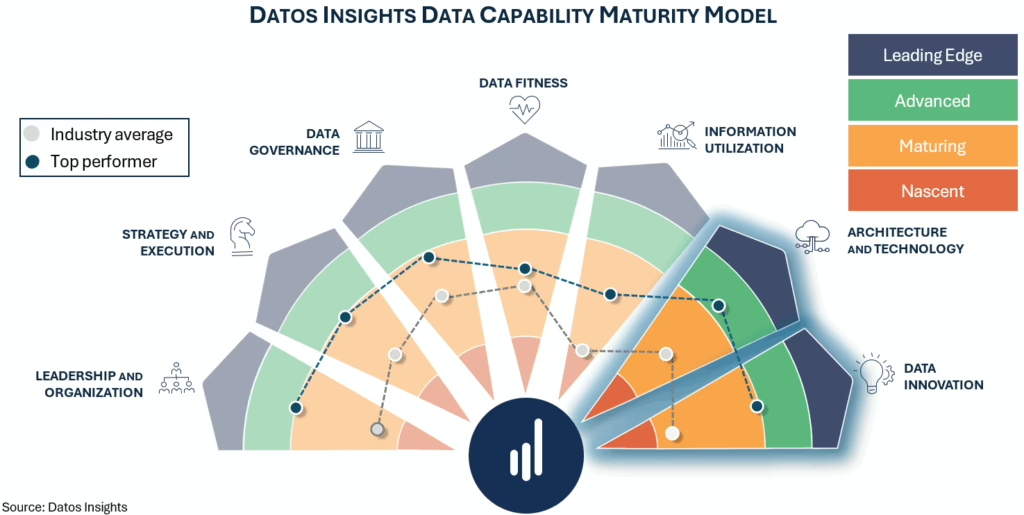
Think of it this way: effective information utilization isn’t possible without solid data fitness, governance that enables rather than restricts, and architecture that supports accessibility. Similarly, meaningful innovation requires strategic leadership, clear execution capabilities, and the technological foundation to experiment safely. The reason these two dimensions stand out isn’t that the others don’t matter—it’s that they serve as the visible proof that all the foundational elements are working in harmony.
This insight reveals why comprehensive assessment across all seven dimensions remains critical. Organizations that excel at innovation and utilization have invariably built strong capabilities in the supporting dimensions, even if those foundations are less visible in day-to-day operations. The companies leading in innovation demonstrate something crucial: they understand the strategic value of data deeply enough to invest not just in the basics, but in pushing boundaries and ensuring insights reach decision-makers effectively.
What’s particularly noteworthy is that top performers don’t necessarily wait for perfect scores across all foundational dimensions before pursuing innovation. Instead, they build foundations that are “good enough” to support experimentation, then use the learning from innovation efforts to continually improve their underlying capabilities. It’s an iterative, virtuous cycle rather than a linear progression.
Size Doesn’t Determine Success: The Mid-Market Opportunity
Another surprising finding is that organizational size doesn’t predetermine data maturity success. Our assessments show midsize insurers achieve top performer status alongside much larger competitors. The key differentiator isn’t budget or headcount—it’s strategic focus and execution.
Successful midsize carriers optimize their limited resources through integrated architectures, strategic automation, and focused use-case selection. They avoid the “tool sprawl” that plagues larger organizations and maintain agility that allows rapid iteration and improvement.
Turning Insights Into Action
These findings emerge from our comprehensive assessment that evaluates carriers across the seven critical dimensions of Datos’ DCMM: Leadership and Organization, Strategy and Execution, Architecture and Technology, Data Innovation, Data Governance, Data Fitness, and Information Utilization. The visual output provides an immediate, visceral understanding of strengths and gaps relative to industry peers.
But the real value comes from the collaborative workshop when we unpack these results with cross-functional teams. Watching IT and business stakeholders discover their different perspectives on the same capabilities often produces “aha” moments that catalyze real change.
The Path Forward
As insurance carriers grapple with AI adoption, digital transformation, and evolving customer expectations, understanding true data maturity becomes critical. The surprising patterns we’re seeing—from the governance-fitness paradox to the innovation advantage—suggest that traditional approaches to data transformation may need fundamental rethinking.
The good news? Every carrier we’ve worked with, regardless of starting position, has identified clear, actionable paths to improvement. The key is getting an objective, outside-in view of current capabilities and building consensus on priorities.
Ready to see how your organization’s data capabilities stack up? Contact us to learn more about the Data Capability Maturity Model assessment program and join the growing community of carriers turning data insights into competitive advantage.