

In today’s digital banking landscape, financial institutions (FIs) face an increasingly complex challenge: delivering robust security while maintaining frictionless customer experiences. As cyber threats evolve and regulations tighten, a one-size-fits-all approach to authentication simply doesn’t work anymore. Our latest research reveals critical insights that could transform how financial organizations approach this challenge.
Why Authentication Personas Matter for Financial Institutions
Authentication is no longer just a technical implementation. It’s a deeply personal interaction that can make or break customer relationships. Datos Insights has identified four distinct consumer authentication personas, each with unique preferences that directly impact their satisfaction, engagement, and loyalty.
These personas aren’t academic classifications—they represent real segments of your customer base with different expectations about how their accounts should be protected. FIs that fail to recognize and accommodate these differences risk creating authentication experiences that alienate significant portions of their customer base.
Active Guardians: Customers Who Demand Control
Active Guardians are highly security-conscious consumers who want control over their authentication processes. These customers, predominantly male (63%) and frequently older (46% are baby boomers/seniors), demonstrate exceptional diligence in their security practices. They’re 24% more likely to use unique passwords for each account and create distinct passwords specifically for online banking (66%).
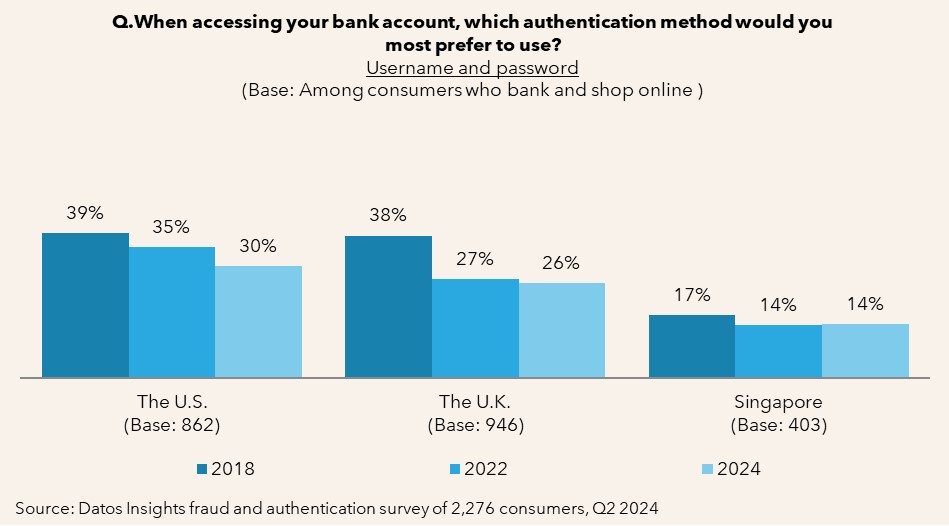
Active Guardians check their banking apps daily and maintain relationships with multiple FIs. They prefer authentication methods like OTPs and username/passwords that provide explicit verification of security processes. For these customers, visible security isn’t friction—it’s reassurance.
Casual Users: Balancing Adequate Protection with Minimal Disruption
Casual Users take a balanced approach to security and convenience. They aren’t particularly concerned about fraud and prefer authentication journeys that provide adequate protection without significant disruption. This group skews slightly younger, with higher representation of Gen Z and millennials.
Casual Users log into banking apps less frequently than security-focused personas and maintain fewer relationships with FIs. They show the strongest preference for easy-to-use methods that still provide reasonable security, including OTPs and two-way text authentication.
Security Delegators: Preference for Invisible Protection
This smaller but distinct segment presents an interesting paradox: they’re highly concerned about security but prefer not to manage it themselves. Security Delegators trust FIs to implement invisible safeguards on their behalf. Despite their hands-off approach, they show the highest abandonment rate after experiencing fraudulent transactions.
Security Delegators skew older (42% baby boomers/seniors) and predominantly live in urban areas (53%). Despite valuing security, they log into banking apps less frequently and are significantly more likely to have disputed legitimate transactions (22%).
Security Perfectionists: Prioritizing Protection Over Convenience
Security Perfectionists prioritize robust protection even at the expense of convenience. This segment demonstrates a willingness to accept significant complexity for enhanced security. They show the highest adoption rate of more advanced authentication methods, with 63% rating fingerprint biometrics as very effective and 52% perceiving facial recognition as very effective.
This group shows the highest educational attainment among all personas and demonstrates sophisticated financial behaviors. They maintain relationships with multiple FIs and show the strongest password hygiene, with 82% using unique passwords for online banking.
The Business Imperative for FIs
The discovery of these distinct personas carries significant implications for FIs:
- Risk of customer attrition: Each persona shows different thresholds for abandonment after security incidents, with Security Delegators most likely to leave after fraudulent transactions.
- Authentication effectiveness: Methods that satisfy one persona may frustrate another, leading to authentication failures, customer support calls, and lost engagement.
- Security perception gaps: While the industry trends toward invisible, frictionless security, many customers (72%-80% across markets) actually prefer security mechanisms they actively manage rather than behind-the-scenes protection.
- Competitive differentiation: FIs that align authentication experiences with customer personas will gain advantage in customer acquisition and retention.
Moving Forward: Implementing Persona-Based Authentication
FIs must develop mechanisms to identify customer segments early in the relationship, tailor authentication journeys accordingly, and measure success using persona-specific metrics. This approach requires coordination across marketing, security, and customer experience teams but offers significant rewards in customer satisfaction and security effectiveness.
The companies that will thrive in this new environment recognize that authentication isn’t just about security technology—it’s about understanding the human element of security preferences.
To learn more about the authentication spectrum, treatment strategies, as well as the demographic factors and individual preferences that shape consumer attitudes and behaviors toward authentication methods, please see our recent report, The Authentication Spectrum: Aligning Security With Customer Personas.