

Strong adoption continues globally, as international and local firms alike invest in self-ordering kiosks to improve efficiency and increase transaction values
Growing global chains help boost kiosk shipments to record high
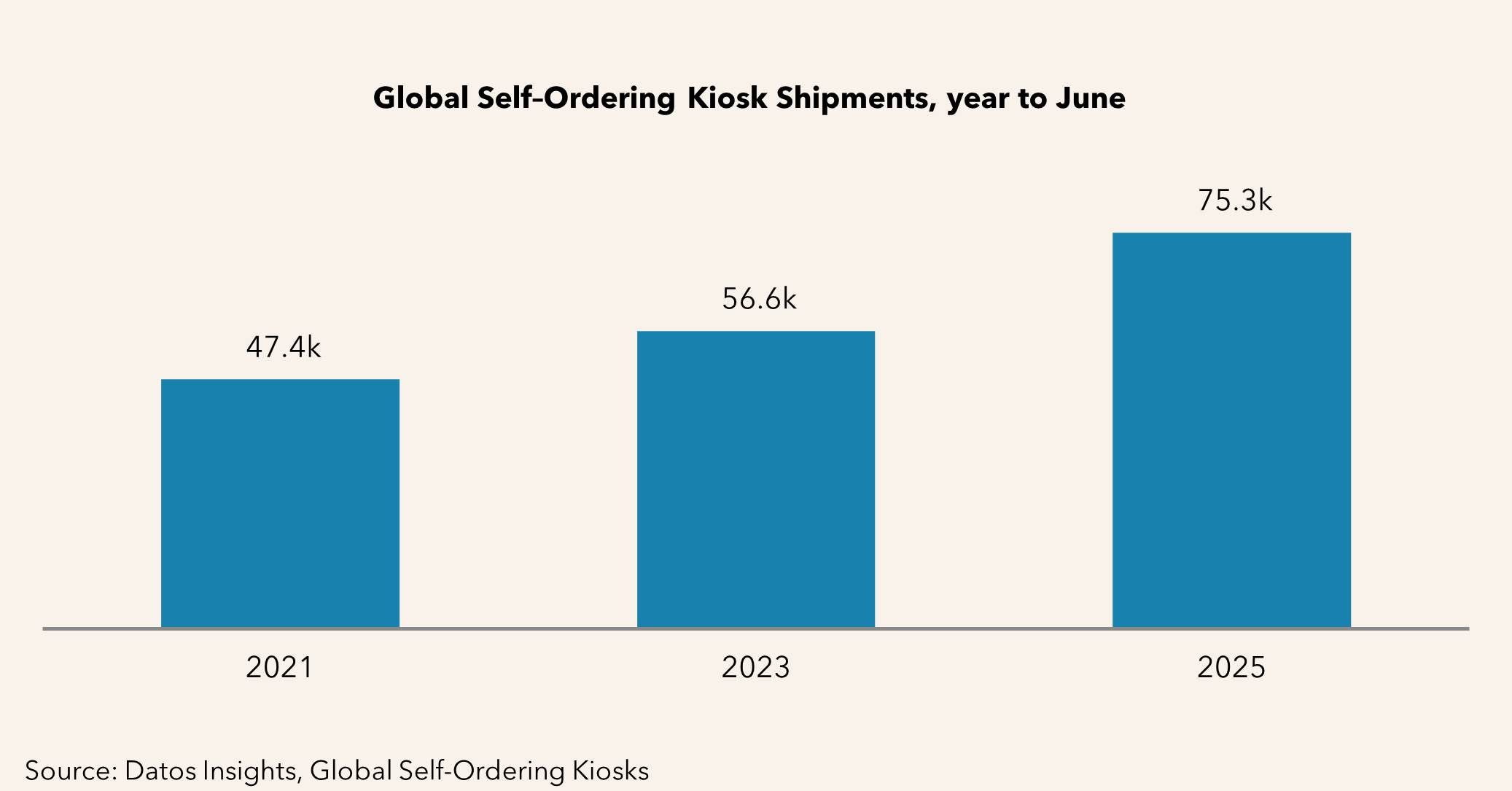
The latest Global Self-Ordering Kiosks research by Datos Insights reveals that a record number of more than 75,000 self-ordering kiosks were delivered to the hospitality industry worldwide in the year to June 2025, with global installations approaching 450,000 terminals.
Global fast food giants Burger King, KFC and McDonald’s continued to expand their kiosk rollouts, including to new territories, while other major brands such as Subway and Dunkin’ have accelerated their investment in the technology. Growing chains, including Popeyes, which has around 5,000 restaurants globally, are deploying kiosks in the countries they enter.
EMEA region sees quickest kiosk market growth
EMEA saw the strongest growth in shipments in the year to June 2025, with close to 28,000 units delivered. In addition to major kiosk deployers continuing rollouts, Popeyes introduced terminals across a range of countries, including in new markets Albania, Italy and Poland. Local chains, such as Frittenwerk in Germany, Enjoy Tacos in France, and Kudu in Saudi Arabia, are also choosing to roll out kiosks.
The Americas accounts for the largest number of installed kiosks, with the USA home to close to one third of terminals in the world. US firms Jack in the Box and Bojangles are among the ever-growing number of quick-service restaurant (QSR) chains to have adopted the technology; the former has deployed kiosks in around 1,500 sites. Elsewhere in the region, there has been strong uptake in Mexico and Argentina, while coffee and bakery chain Tim Hortons has ramped up its kiosk estate in Canada.
Kiosks are a key pillar of fast-food chains’ digital transformation strategies in Asia-Pacific too, with KFC rolling out terminals in markets including the Philippines and India. Local brands in South Korea such as coffee chains Ediya Coffee and theVenti have also invested in the technology.
Coffee chains and retailer cafés embrace kiosks
Self-ordering terminals are becoming more common beyond traditional quick service. Global coffee giant Starbucks is trialling units in Japan and South Korea, and was set to introduce kiosks to US airport-based locations in late 2025. Retailers as diverse as Swedish furniture chain IKEA and UK grocery firm Tesco have increasingly deployed self-ordering terminals in their in-store cafés.
Acrelec is the largest kiosk supplier globally
Global technology firm Acrelec, part of Glory Group, has the largest share of the market, representing 21% of self-ordering kiosk hardware shipments worldwide in the year to June 2025. Its customers include McDonald’s, Burger King, KFC and Taco Bell. Acrelec is also the largest supplier of kiosk software globally.
Further major international hardware vendors include Coates Group, Diebold Nixdorf, Elo (now part of Zebra Technologies) and Evoke. Chinese suppliers HiStone, Taiyun and Telpo all have a strong presence in their home market. Consumer-grade iOS and Android devices are also commonly deployed as kiosks, as are systems from restaurant POS and management firm Toast.
Software plays a key role across digital channels. US company Tillster works with a range of QSR brands across both the Americas and Europe, while other restaurant specialists including Bite, GRUBBRR, Qu and Shift4 all have a strong presence in the USA. Other major software suppliers include Rydeen and Sixun in China, Foodics in the Middle East, Fingermark in Australia and Vita Mojo in Europe.
Appetite for kiosks expected to continue as digitalisation investment ramps up
The uptake in self-ordering kiosks is expected to remain strong, with businesses harnessing the technology as part of digital modernisation projects to boost store efficiency, order entry accuracy and ticket sizes. In an increasingly difficult labour market, the terminals are also mitigating staff shortages and spiralling costs.
As both international QSR chains and local firms continue to invest in kiosks, and the technology penetrates further sectors, including coffee chains, the global market is set to see healthy growth. Datos Insights forecasts that the total number of kiosks installed worldwide will approach 750,000 by 2030.
Notes to editors
About Datos Insights
Datos Insights is the leading research and advisory partner to the banking, insurance, and securities industries—both the financial services firms and the technology providers who serve them.
In an era of rapid change, we empower firms across the financial services ecosystem to make high-stakes decisions with confidence and speed. Our distinctive combination of proprietary data, analytics, and deep practitioner expertise provides actionable insights that enable clients to accelerate critical initiatives, inspire decisive action, and de-risk strategic investments to achieve faster, bolder transformation.
The information and data within this press release are the copyright of Datos Insights and may only be quoted with appropriate attribution to Datos Insights. The information is provided free of charge and may not be resold.